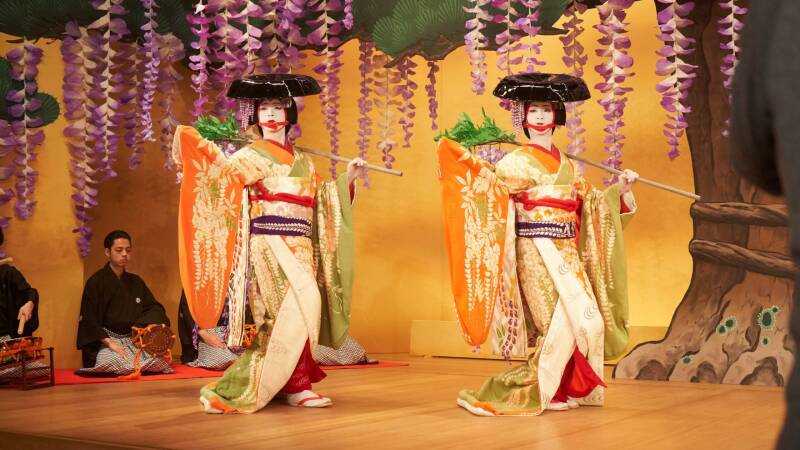
An intense look at this particular part of Japanese culture that showcases the journey to achieving greatness and the cost to maintain it.
Going to this film and not even reading the synopsis or the meaning of what a Kokuho was, I have to say that I was very confused as to where the story was going early on in the first act, but the film does a great job at slapping you in the face with the protagonists back story and motivations. I think the screenplay by Satoko Okudera is great in terms of pacing and character development. Every character has a distinct voice and background that are so different and yet when they interact with one another the raw emotion feels so natural.
That natural feeling doesn’t happen without the performances. Ryo Yoshizawa and Ryusei Yokohama absolutely destroy their roles here as Kikuo Tachibana & Shunsuke Ôgaki respectively. Obviously they are the movie, the love and hate you get from them is spectacular. They both go through very similar paths but the paths just look so different because those paths are the reflections of who they truly are. I really feel if there was a bigger push for Yoshizawa, he could have definitely gotten an Oscar nod if Wagner Moura was able to get it. This performative artform can’t really be faked, so he really had to go through. I can also see the fact that since his background is from a Japanese superhero franchise, that he would want to break his mold and showcase his acting talent with a role that demands such commitment.
The supporting cast are all great, they all stick out and are important to the story. Even the characters with a lot less screen time maximize the time that they have on screen by impacting the main characters. Even Nana Mori as Akiko, who probably only has maybe 10 minutes of screentime towards the end of the second act, does her job perfectly. She showcases how self-centered and manipulative Kikuo is.
In many ways this film displays a tragedy and how your foundations can be a premonition of where you’ll end up in life. I think the structure of telling this story over decades is smart, and although I don’t think every transition does this, when we get a time skip, I feel for the most part that they do a great job of establishing characters motivations and change to their well beings.
For the overall aesthetic, I think the cinematography and sound design is on point. There’re shots for certain performances that make me say “wow, that looked like it was difficult to shoot” and there’s good swooping shots on stage that I think look great! I do think there’s too many close ups on the actors faces that were really unnecessary, you rob the actors of the opportunity to use their whole body in a scene when you close up at important scenes. With a beautiful set design that goes from 60s’ to present day, it just feels like a missed opportunity for some parts of the movie. Also, at a runtime of nearly 3 hours, I don’t think it maximized every second, I feel like you could have cut 30-45 minutes of story and it would have been the same movie.
For an American audience, I can understand the disinterest in this story since the closest thing we have to Onnagata in the states would be drag shows and there’s a stigma around that artform. Also, I can see how turned off you can be by this film after finding out that the director, Lee Sang-Il, is probably a misogynist but that’s probably still ok in Japan. All reasons like that are perfectly justifiable to look at this film in a different light. I’m not saying that my reasoning for liking the film is the antithesis to the aforementioned reasons, all I’m saying is that I found a majority of the story and the performances so robust and entertaining.
🌟🌟🌟🌟1/2
Add comment
Comments